
Google’s AI search guide: what matters in 2026?
Google’s advice helps you decide which website jobs deserve your time and which you can leave alone.
 Steen Stones · Reviewed
To help people find you in Google’s AI search, keep doing sound SEO and share knowledge of your own. Google asks for clear writing, with no requirement for special AI files or special schema.
| What to check | Google’s guidance |
|---|---|
| Search eligibility | The page must be indexed and eligible for a Search snippet. |
| AI inclusion | Check that the site is included in Search generative AI features in Search Console. |
| Page content | Use original knowledge and write clearly for people. |
| Images and video | Add relevant, high-quality media where it helps the reader. |
| Special AI files and schema | Neither special AI files nor special schema markup is required. |
| Word count | There is no ideal page length. |
What should you spend time on?
Start with what your company knows from doing the work. Google asks for original knowledge, rather than another version of information already online.
Imagine a software company explaining a difficult move between products, including the choices it faced and what went wrong. It could show how the team fixed those problems. This is an example of applying the guidance, not a reported customer result.
Make the explanation easy to follow, because Google asks you to write clearly for people. Add relevant images or videos where they help someone understand it.
Can Google use your pages?
Your page must qualify before Google can use it. It needs to be in Google’s search index and eligible for a snippet, the short text beside a search result.
Then check Search Console, Google’s website reporting tool. Under Settings, choose Search generative AI and check that your site is included in those features.
Passing these checks lets Google consider your content for its AI features. It does not tell you whether Google will choose that content.
Which AI shortcuts can you skip?
You can leave special AI text files off the list of requirements for Google Search. Google says it does not use them, or Markdown copies of pages, for this purpose.
There is no ideal word count to aim for either, according to Google. Write enough to answer the reader’s question, then stop.
Schema labels information in a page’s code, but special schema is not a requirement for Google’s AI search features. An offer to add it is not an entry ticket.
What can you measure in 2026?
Google says its Generative AI performance report had reached websites worldwide by 31 August 2026. Older advice may still describe an earlier stage of that rollout.
The report counts impressions, meaning how often links to your site appeared in Google AI search features. Those appearances tell you about visibility, not how many people bought from you.
If the report is missing, Google says the usual reason is that your site has not had enough AI impressions. That alone does not mean your website needs a technical repair.
Recognise the AI impressions report
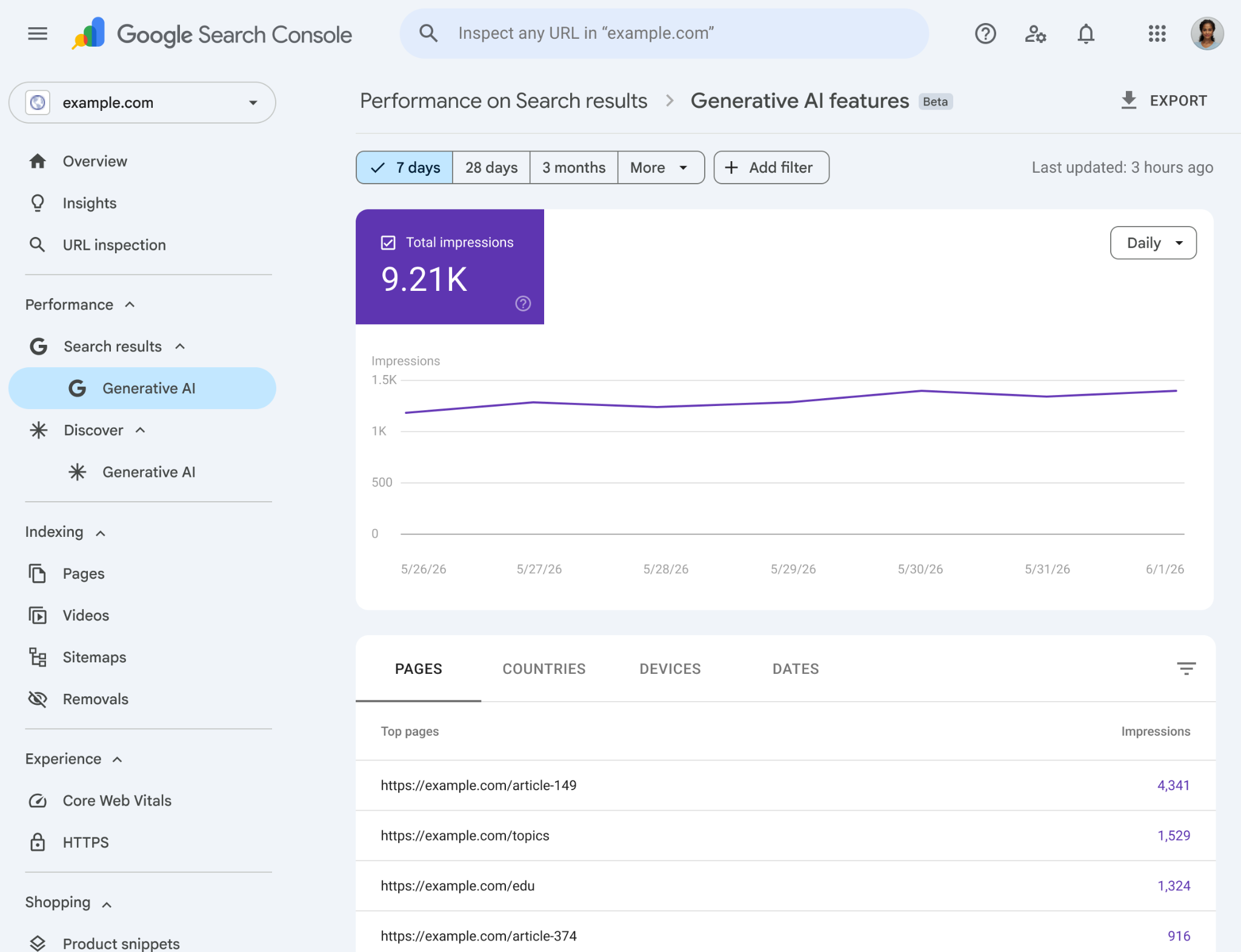
Google’s June 2026 example, reused unchanged. All figures shown are demonstration data, not Avouch results or a current reading of your website.
 Open full-size screenshot in a new tab
Select the screenshot to enlarge it.
- Total impressions
- This counts occasions when links to the site appeared in Google’s AI features. It does not show how many people bought.
- If you cannot see the report
- Google says the usual reason is too few AI impressions. The example shows what the report looks like when available.
Source: Google Search Central, CC BY 4.0
What is worth checking next?
We would start with a page that matters to your business and check that it qualifies for search. Check AI inclusion too, then read the answer and ask what first-hand knowledge would make it more useful.
Google Business Profile and Merchant Center are also worth checking where they suit your business. Google says they can help products and services appear in AI responses and other search results.
Choose the work that helps your reader, such as a clearer explanation or an image that makes it easier to understand. Google does not ask you for a special AI file or a fixed page length.