Google algorithm updates in 2026: what changed for AI search
Check what changed before deciding which part of your site needs work.
 Steen Stones · Reviewed
Google’s 2026 changes include core updates in March and May, spam updates, new AI models and new reporting. Google says its AI features still depend on core Search ranking and quality systems, so SEO remains part of the work.
Which Google ranking updates happened in 2026?
| Google update | Start date |
|---|---|
| February Discover update | 5 February 2026 |
| March spam update | 24 March 2026 |
| March core update | 27 March 2026 |
| May core update | 21 May 2026 |
| June spam update | 24 June 2026 |
| August spam update | 18 August 2026 |
| September spam update | 24 September 2026 |
Where to check Google’s announced updates
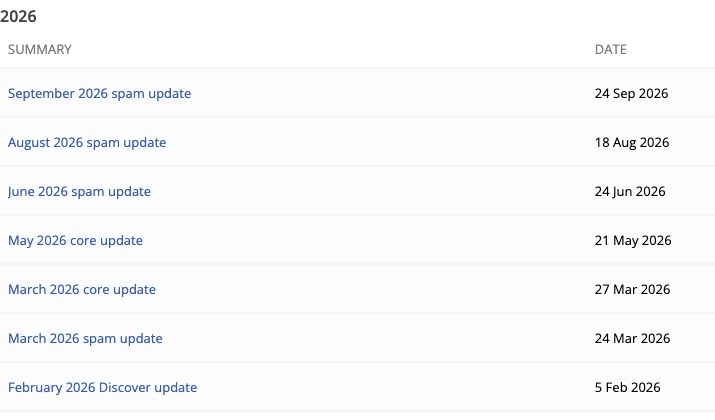
Google Search Status Dashboard, captured 7 October 2026. Cropped to the update names and dates; the duration column and other years are omitted.
 Open full-size screenshot in a new tab
Select the screenshot to enlarge it.
- Read the update name
- The source distinguishes core, spam and Discover updates. The table above transcribes every name and start date in this crop.
- Check the date first
- Use the listed start date to organise the investigation. A timeline alone cannot explain why your traffic changed.
Google’s status history lists a Discover update beginning on 5 February 2026, followed by a spam update on 24 March. The March core update began on 27 March, and the May core update began on 21 May.
Further spam updates began on 24 June, 18 August and 24 September 2026. Google’s September notice says that update applies worldwide, across all languages, and may take up to two weeks to roll out.
A core update changes Google’s systems broadly; it is not aimed at one site or page. Use the date to begin your investigation, without treating it as the explanation for your results.
What changed in AI Overviews and AI Mode?
On 27 January 2026, Google announced Gemini 3 as the default model for AI Overviews globally. It also announced a direct move from an AI Overview into an AI Mode conversation on mobile worldwide.
On 6 May 2026, Google announced more links beside the relevant text in AI answers. It also added previews of perspectives from public discussions, social media and other firsthand sources.
On 19 May 2026, Google announced Gemini 3.5 Flash as the default AI Mode model worldwide. That announcement describes the AI search experience. Google records core updates separately in its ranking history.
Can you now measure appearances in Google’s AI answers?
Yes. Search Console’s new insights show impressions, the pages appearing in AI responses and the countries where they appear. Google says these website-owner features reached all websites worldwide by 31 August 2026.
Open the Generative AI performance report in Search Console. Google recommends it for reviewing how your content appears in AI features on Search and Discover.
We would start with which useful pages are being found and what work should follow. Read that alongside your business results before deciding where to put more budget.
What does Google’s new AI-search control do?
The Search Console control lets you opt out of Google’s generative AI search features. Google says that removes traffic and impressions from those features, but does not affect how it ranks other search results.
For a page to appear in Google’s AI search features, it must be in Google’s index and eligible for a search snippet. The site must also be included in Search generative AI features in Search Console.
What should you check after a core update?
Look at the affected pages and search queries before making changes. Google recommends waiting at least a full week after a core update finishes. Then compare how your top pages and queries ranked before and after the update.
We would use the timeline to organise the investigation. Write down what changed on the affected pages and what you want to improve. The dates alone cannot explain why traffic fell.
Keep the work focused on something useful to the reader. Google recommends original content with expert knowledge beyond what is already commonly available.
Does AI search mean you should stop doing SEO?
No. Google says its generative AI features are rooted in core Search ranking and quality systems, which is why SEO remains relevant. Its guidance combines that foundation with original expert content and measurement through Search Console.
Use the announcements to decide what to check. We would keep the plan tied to your useful pages and buyer questions, rather than each new model name.