What is generative engine optimisation (GEO), and is it real?
Before putting money into GEO, ask what work you are buying and how its results will be measured.
 Steen Stones · Reviewed
Generative engine optimisation (GEO) means improving content so it appears more often in AI-generated answers. Yes, the work is real. Researchers have tested changes that improved visibility, and Google publishes guidance for its AI search features. That supports doing the work, but gives no fixed uplift to expect from it.
What does GEO actually involve?
GEO is about getting content into a generated answer. The original research defines its purpose as increasing a content creator’s visibility in those answers.
For Google, established SEO practices still matter because its AI search features use the core Search ranking and quality systems. Google also asks for original content that adds expert knowledge or experience beyond what is already commonly known.
We would expect a GEO proposal to name the questions your company needs to answer and what its content will add. Ask how the work will help the reader before accepting a new label as a reason to spend.
What evidence says GEO works?
| Evidence | What it supports | How to read it |
|---|---|---|
| GEO research paper | Visibility improved by up to 40% in the evaluation, with results varying by subject. | An experimental result, not a forecast for your company. |
| Google’s AI-search guidance | Established SEO practices remain relevant. | Google’s position applies to its own search features. |
| Ahrefs citation study | 28.6% of Perplexity’s cited URLs also appeared in Google’s top ten in that study. | A measured example, not a current benchmark. |
| Bing’s Citation Share guidance | An observational measure of citations. | It does not measure traffic share or score content quality. |
The GEO paper reports visibility gains of up to 40% in its tests, with results varying by subject. The experiment used gpt3.5-turbo to generate answers, and the authors say methods may need to change as engines evolve. The result shows what worked in that experiment. It is not a forecast for your company.
For any proposed improvement, we would ask what changed, which engine was tested and what the result measured. Then test it against the questions that matter to your business.
Is GEO just SEO with a different name?
- Perplexity citations also in Google’s top ten28.6%
Source and study details
Ahrefs, Only 12% of AI Cited URLs Rank in Google’s Top 10 for the Original Prompt, https://ahrefs.com/blog/ai-search-overlap/. Data collected in early July; source checked 7 October 2026.
Google’s guidance gives SEO and GEO plenty of common ground. SEO practices still matter, and Google requires no special schema.org markup for generative AI search. These are the machine-readable labels added to a page.
But it is still worth examining the AI answers themselves. Google says AI Overviews and AI Mode may run several related searches to build an answer. So the words someone types can be only part of what Google searches for.
Ahrefs compared 15,000 long-tail queries across conventional search and AI assistants. Of the URLs Perplexity cited, 28.6% also appeared in Google’s top ten in that study. Ahrefs collected the data in early July and says results may have changed. It is a measured example of the difference, not a current benchmark.
What should you measure?
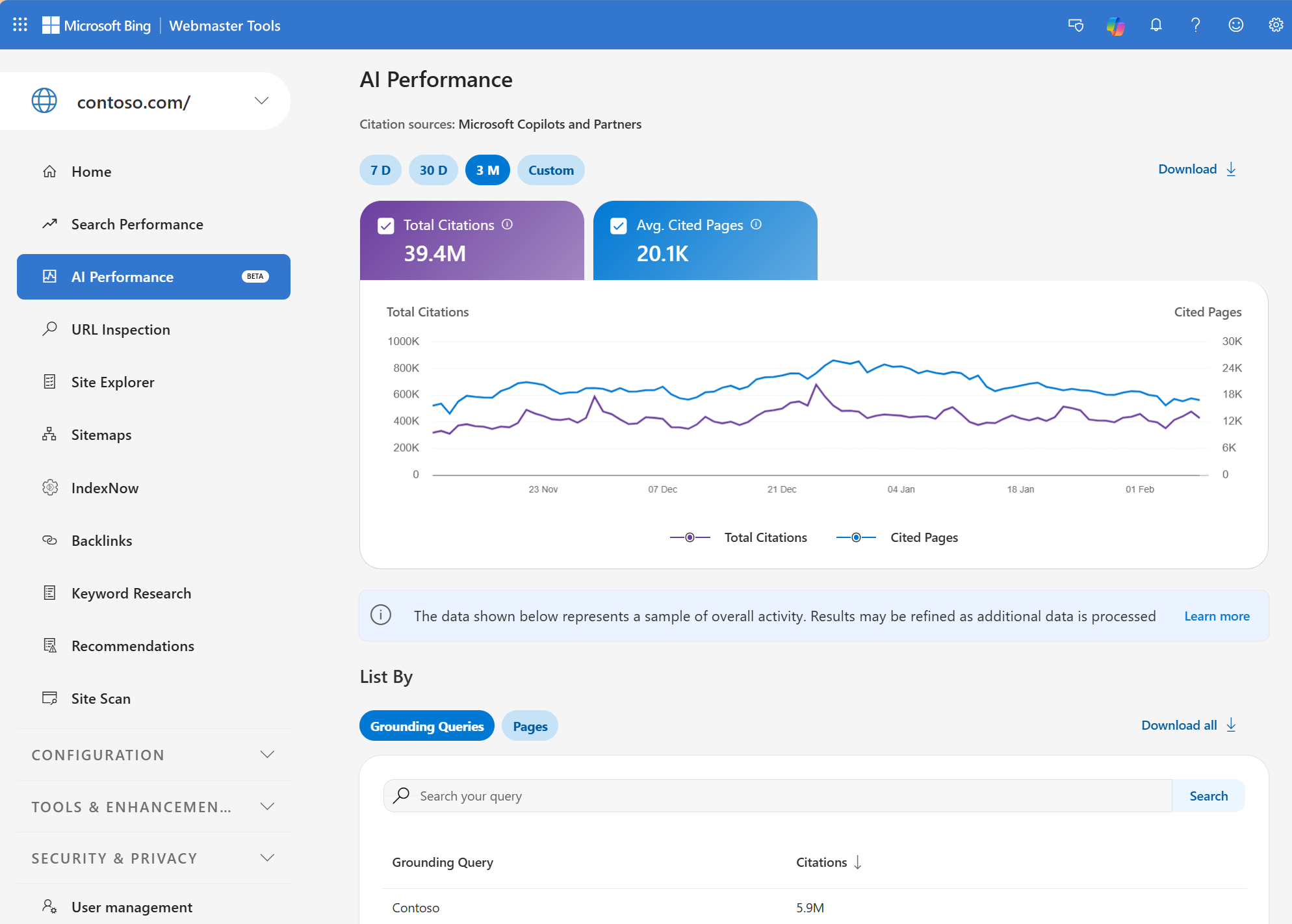
What an AI citation report looks like
Microsoft’s published example, February 2026. The screen uses demonstration figures for contoso.com, not Avouch results. Reused unchanged; the chart is an illustration of the report, not evidence of an uplift.
 Open full-size screenshot in a new tab
Select the screenshot to enlarge it.
- Read the labels before the trend
- The example plots citations and cited pages. Its example numbers are not a benchmark for your company.
- Keep the business question beside the report
- Read visibility alongside enquiries and revenue, and check whether the answer actually recommends your company.
Google points publishers to the Generative AI performance report in Search Console to measure how content performs in its generative features. It also suggests tracking conversions and time on site with tools such as Google Analytics.
Bing’s AI Performance Report covers Microsoft Copilot, Bing and selected partner AI experiences. Its Citation Share measure records what appears, but Bing says it does not measure traffic share or score content quality.
We would read those visibility measures alongside enquiries and revenue. Check whether the answer mentions your company, cites your content or recommends you for the job. There’s a difference between showing up and being recommended.
How do you judge a GEO proposal?
Ask where you stand now, what the supplier will change and how they will judge the result. The proposal should explain how that change could help someone choose you.
Ross Simmonds puts the priority plainly: do work that benefits people, whatever you call it. His point is about where to put the effort, not evidence of a measured uplift.
Do things that add value to your customers whether it's for GEO/AI SEO purposes or not.