
How often do AI answers change their sources in 2026?
Our daily tracking found that about half of the websites AI cites for a question change from one day to the next. What that means for measuring your visibility.
 Steen Stones · Reviewed
Photo: RDNE Stock project / Pexels
Often. In our own daily tracking of UK business questions, about half of the websites that Google’s AI tools cited for a question were new compared with the day before. SISTRIX found a similar rate of change from week to week in UK AI Mode and ChatGPT answers. So one check, or one good day, tells you little. Measure the same questions over several weeks.
Avouch’s free scan shows which companies AI recommends in your market.
- Gemini59%
- Google AI Overviews47%
- Google AI Mode36%
- All three tools52%
Source and study details
Avouch daily tracking, UK, 21 September to 21 October 2026. 2,797 day-to-day comparisons across two question sets. Websites, not pages.
What our tracking found
Every day we ask the same UK business questions in Google’s AI tools: one set about AI SEO services, and one about data protection and cyber security services. Between 21 September and 21 October 2026, we compared the websites each tool cited for each question with the websites it cited the day before.
- About half changed overnight. 52% of the websites cited on a given day had not been cited for the same question the day before.
- The full list rarely stayed the same. Only 1 in 8 times did the next day’s answer cite exactly the same websites.
- AI Mode was the steadiest, Gemini the least steady. 36% of AI Mode’s cited websites were new each day, 47% of AI Overviews’ and 59% of Gemini’s.
- Both question sets showed the same pattern: 51% and 52%.
These figures cover Google’s three AI tools in the UK. We did not ask ChatGPT every day in this period. They count websites, not individual pages, and they measure which websites were cited, not which companies were recommended.
What other studies found
- Week to week, in the UK. SISTRIX tracked AI answers for 17 weeks, from December 2025 to April 2026. In the UK, 54% of the websites cited in AI Mode each week were new compared with the week before. For ChatGPT search, it reported a UK drift rate of 60%.
- AI Overviews can be steadier. In the same study, 53% of AI Overviews questions kept exactly the same sources for all 17 weeks.
- Within the same day. SE Ranking asked AI Mode 10,000 questions three times on one day in June 2025, in the US. Only 9.2% of the links appeared in all three answers.
Each study measures change in its own way, so compare the direction of the findings, not the exact percentages.
Search changes daily, training data changes slowly
The figures above are about answers that search the web. An AI tool can also answer from what its model learned in training, without searching. OpenAI says that knowledge stops at a fixed date and does not include later events unless the tool searches. So there are two speeds of change:
- Answers that search the web can cite different websites from one day to the next, as our tracking shows.
- Answers from training data change only when the AI company releases an updated model, so a correction to your website does not reach them straight away.
Both depend on AI tools being able to read your website. Our guide to what to do when ChatGPT gets your company wrong explains how to correct each kind of answer.
See the AI robots that read your website
You can see both kinds of reading on your own website. AI companies send robots to read web pages for different jobs, and your website host records each visit:
- Live reads to answer a person: a robot fetches your page because someone asked an AI tool a question just now. OpenAI’s is called ChatGPT-User.
- AI search indexing: a robot reads your pages so the AI tool can find them in later searches. OpenAI’s is OAI-SearchBot.
- AI training crawls: a robot collects pages that may be used to train future models. OpenAI’s is GPTBot.
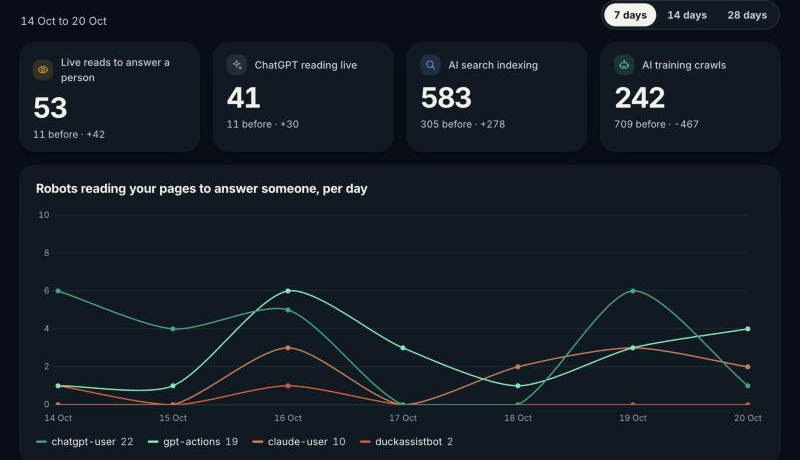
AI robots reading avouchedfor.com in one week
Our own website, avouchedfor.com, 14 to 20 October 2026, in the Avouch dashboard. Visits as counted by our website host.
 Open full-size screenshot in a new tab
Select the screenshot to enlarge it.
- Live reads to answer a person
- 53 in the week. Each one is a robot reading a page because someone asked an AI tool a question.
- AI search indexing and AI training crawls
- 583 indexing visits and 242 training visits in the same week. Training visits feed future models, so they change answers slowly.
If the robots cannot get in, nothing on this page applies to your website. Our guide to AI crawlers explains how to let the right ones in.
What this means for you
Do not judge your visibility on one check. Ask each question on several days, and compare weeks, not single days.
Keep the method fixed. Use the same questions, AI tools and country each time, so a change in the result is a change in the answers. Our guide to AI visibility metrics explains how to count them.
Report trends, not snapshots. A single appearance does not mean a lasting position, and a single absence does not mean you have lost one.
Be found in more than one place. The websites AI cites keep changing, so it helps to have accurate information on your own website and on the directories, review sites and publications in your market. Our guide to why AI recommends your competitors shows how to find those websites.
How Avouch can help
We ask the same buyer questions on a fixed schedule and report the trend, not one day’s answers. In the Growth Stress Test, we measure how often AI recommends your company and which websites it relies on. Where it is part of an agreed engagement, we track your Recommendation Rate™ each week and, where we can read your website host’s records, show the AI robots that visit your website, with scope and price agreed before we start.
Want to know where you stand?
Start with the free scan. To see where you lose buyers, from the AI shortlist to the follow-up, choose the paid Growth Stress Test.