First, it has to know you.
Before it can recommend you, AI has to be sure who you are.
Start free. No commitment.
What AI says
Illustrative example, not a real clientUser prompt: “Tell me about Quillmoor.”
ChatGPT
★ One business, one set of facts
AI will not recommend you if it cannot pin you down.
If it is not sure whether you are you, or it mixes you up with another office, another product, another business of the same name, it plays safe and names someone it is certain about. Most businesses have never been made easy for a machine to read. That is the first gap we close.
How we work
Build the page that is definitively you
One page says who you are, what you do and where you do it. Every other mention of you points back to it.Get you into the records AI checks
AI checks a small set of reference sources before it answers. We get you into them, so the facts they hold about you are yours.Make the facts agree
Your name, your location, your registration and your people read the same everywhere AI looks: your own site, Companies House, LinkedIn, the directories.
What you get
The page that is definitively you
One page, written so a machine can read it, that everything else about you points back to.
A record in the sources AI checks
A clean entry in the reference sources AI relies on. The panel beside a search result usually appears in two to three months.
Labels that only confirm
The hidden labels machines read, saying only what a person can already see on the page. Never a claim the page does not make.
The work, in order
Find out what AI thinks you are
Where it is unsure, wrong, or silent about who you are. Measured, one engine at a time.Build the page, label it properly
We write the page that defines you and label it in the format machines read.Make everything else match
We line the facts up across every source AI cross-checks, so nothing anywhere contradicts anything else.
One page, one record, one set of facts
Being known is built in three moves, in this order: one page that defines you, a record in the sources AI checks, and the same facts everywhere else.
One page
The page that is definitively you, and the one everything points back to.
One record
A clean entry in the sources AI checks before it answers.
One set of facts
The same name, status and people, everywhere AI looks.
How we’re different
| Dimension | Avouch | Typical agency or tool |
|---|---|---|
| The hidden labels | Only ever repeat what is on the page | Stuffed with claims the page does not back |
| Where the facts live | One page that settles it | Scattered across pages and profiles |
| Keeping them straight | Lined up across every source AI checks | Left to drift, profile by profile |
Tracked on the Citation Intelligence Platform.
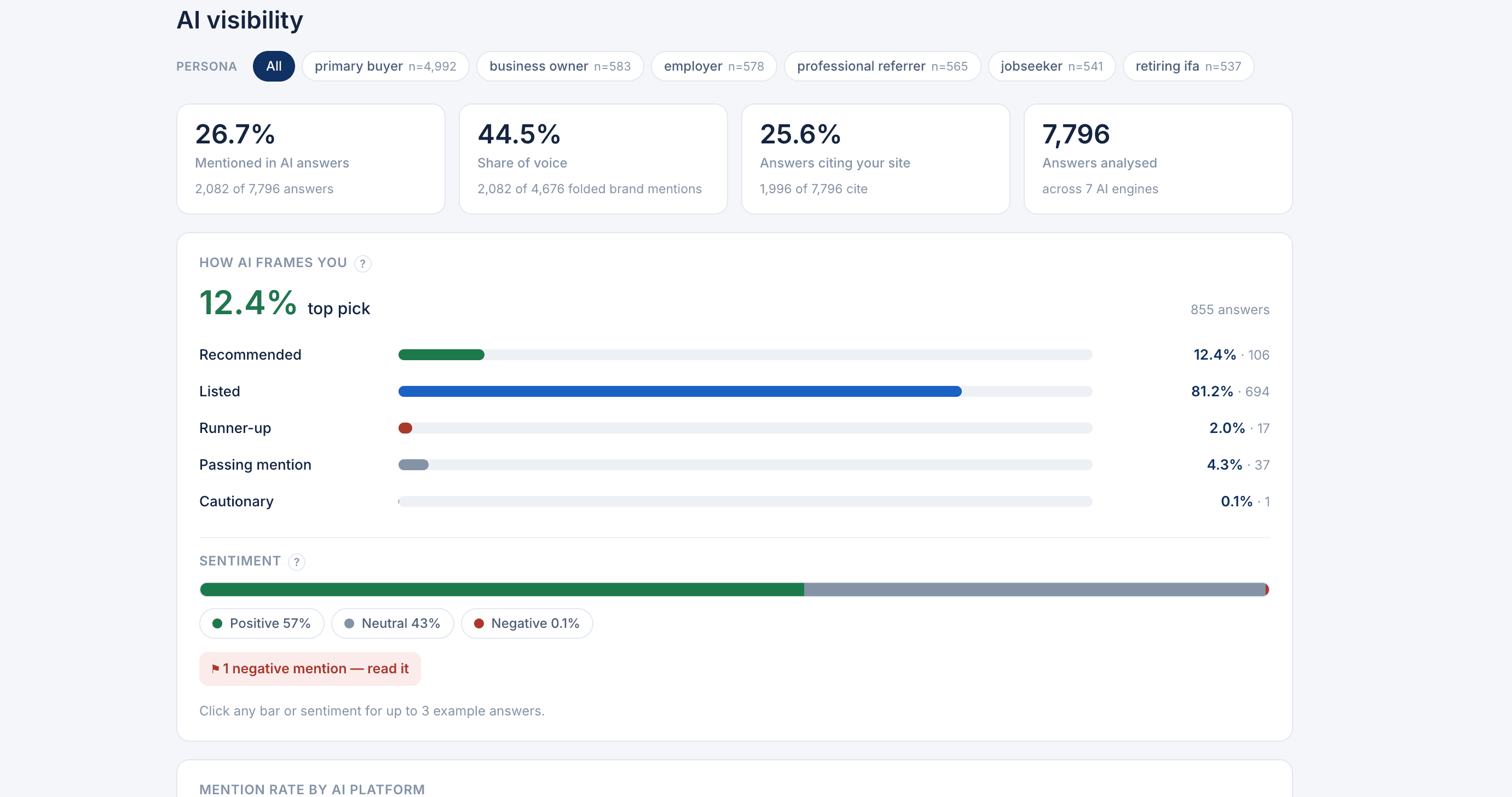
Our own database measures whether AI can identify you cleanly, and flags where it is still unsure, or still saying something untrue, one engine at a time.
Usually the first part of the retainer, because everything else is built on it.
Foundations questions
- What do you mean by “the page that is definitively you”?
- One page that settles who you are, what you do, who you work for and what you are registered as. Every other mention of you points back to it, so AI has one place it trusts instead of piecing you together from scraps.
- Isn't this just adding hidden labels to the site?
- Those labels are part of it, and the smallest part. The real work is making your identity consistent and checkable everywhere AI looks. A label only ever repeats what a person can already see on the page.
- How long before that panel appears beside a search result?
- Often two to three months. Getting fully established takes longer. We measure it either way, so you can see it moving rather than take our word for it.
AI can't recommend what it doesn't know.
Start free. No commitment.