
What SEO keyword lists miss about buying decisions
Our comparison of client keyword lists, public buyer questions and recorded AI searches found gaps in the decisions behind the service terms.
 Steen Stones · Reviewed
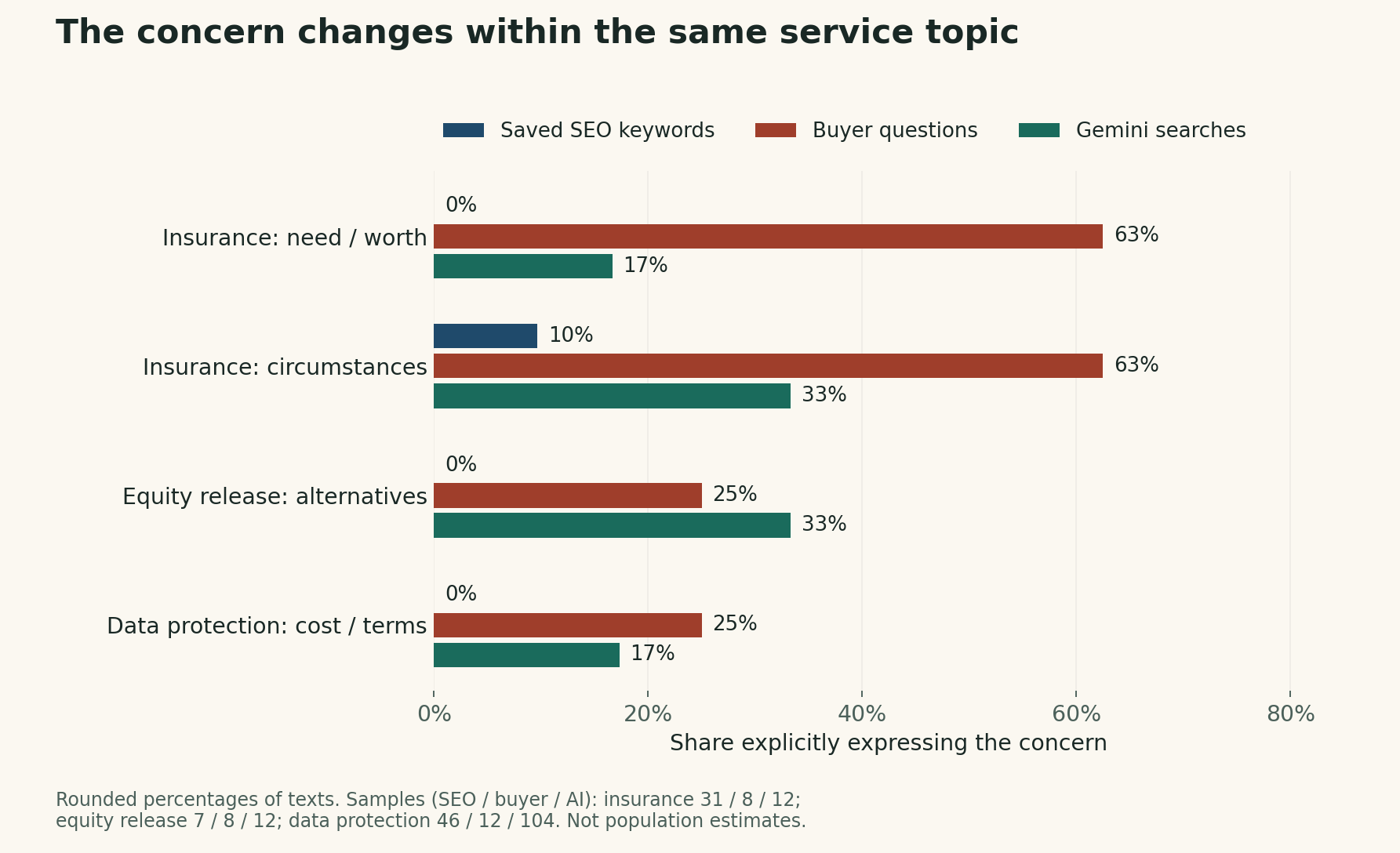
63% of the insurance buyer questions in our sample asked whether cover was needed or worthwhile. That concern appeared in 0% of the saved SEO phrases, while 39% concerned prices or quotes.
The distinction matters when you are planning content. A quote page helps someone compare the cost of cover. A person still deciding whether they need cover has an earlier question to settle.
One buyer put it like this:
Income protection worth it for 28yo engineer?
“Income protection” identifies the product. The buyer's question adds their circumstances and asks whether the product is worth buying. The surrounding discussion adds concerns about existing resources and exclusions.
We wanted to know how much of that decision appeared in our clients' saved SEO keyword lists. We compared the phrases with public buyer questions and AI searches on the same topics.
The comparison found gaps in the saved lists. It also found detailed buying questions in the clients' Google query data. That second finding matters: the evidence supports looking beyond a keyword list, while showing that wider SEO data can already provide part of the answer.
What we compared
We analysed 147 saved SEO phrases, 31 source-checked buyer questions and 235 searches reported by Gemini, across four topics in two client markets: financial services and data protection. Client identities remain private.
| Topic | SEO phrases | Buyer questions | Gemini searches |
|---|---|---|---|
| Adviser and retirement planning | 63 | 3 | 107 |
| Equity release | 7 | 8 | 12 |
| Protection insurance | 31 | 8 | 12 |
| Data protection | 46 | 12 | 104 |
The public questions came from discussions collected for client research. Their authors were considering their own, their family's or their organisation's needs. They are not confirmed customers of the clients.
The Gemini searches came from 64 separately designed research questions. They show what Gemini 2.5 Flash reported searching while answering those questions. The public posts and AI runs were matched by topic; we do not know whether those forum authors used AI.
This is a comparison of selected texts, with small buyer samples and deliberately designed AI questions. It measures what those texts express, rather than how often all buyers think or search in a particular way.
The gap was in the decision being made
We read each phrase, question and AI search for the concerns it explicitly expressed. These included cost, alternatives, trust, circumstances and whether a service was needed. A single text could express several concerns.
The difference is visible when the wording sits side by side:
| Saved SEO phrase | Public buyer question | Recorded Gemini search on the same topic |
|---|---|---|
| income protection | Income protection worth it for 28yo engineer? | do I need life insurance or income protection |
| equity release | Equity Release Alternatives? | downsizing pros and cons |
The buyer questions and AI searches are separate records. The first row concerns whether cover is needed; the second concerns other ways to solve the underlying problem. Insurance discussion [1], equity-release discussion [2].
Four measured comparisons show which concerns were present:
Which buying concerns appeared
Figure 1. Percentage of selected texts expressing each concern, rounded to the nearest whole percent. One text can express several concerns. Sample sizes: insurance, 31 SEO phrases / 8 buyer questions / 12 Gemini searches; equity release, 7 / 8 / 12; data protection, 46 / 12 / 104. Source: Avouch Study 1, analysed 16 October 2026. These are small, selected samples, not estimates for all buyers.
 Open full-size chart in a new tab
Select the chart to enlarge it.
Source: Avouch Study 1: numeric results
| Concern | SEO phrases | Buyer questions | Gemini searches |
|---|---|---|---|
| Insurance: whether cover is needed or worthwhile | 0% | 63% | 17% |
| Insurance: particular circumstances | 10% | 63% | 33% |
| Equity release: alternatives or comparison | 0% | 25% | 33% |
| Data protection: cost or contract terms | 0% | 25% | 17% |
Insurance buyers were still deciding whether to buy
The saved insurance phrases included “life insurance”, “income protection” and “life insurance quotes over 50”. The last example already contains a useful buying detail. The issue is how much of the decision the list covers.
63% of the buyer questions asked whether cover was needed or worthwhile. 63% also expressed particular circumstances, such as age, family or difficulty obtaining cover. Only 10% of the SEO phrases expressed a circumstance beyond location.
Those concerns change what a useful answer needs to explain. A person asking whether insurance is worthwhile may need to understand how it relates to existing cover or resources before comparing providers or prices. The category term alone leaves that decision unstated.
Equity-release buyers wanted to understand other options
The saved phrases covered equity release, location variants and “lifetime mortgage”. 0% explicitly asked about alternatives, compared with 25% of the buyer questions, including the short title “Equity Release Alternatives?” [2].
This question is only three words long. Its value is the decision it expresses. Someone asking about alternatives is considering whether to use the product at all.
The separate Gemini records investigated that decision too. 33% of the equity-release searches concerned comparisons or alternatives. One search set moved beyond equity release into downsizing and other financing options, as the full example below shows.
Data-protection buyers brought cost into the question
33% of the saved SEO phrases asked for definitions or explanations, including “what is a dpo”. A DPO is a data protection officer. 0% of the phrases expressed cost or contract terms.
25% of the buyer questions did. A solo app developer asked:
How do solo devs handle a DPIA without breaking the bank?
A DPIA is a data protection impact assessment. Here the buyer is trying to arrange the work within a limited budget. Explaining what an assessment is answers only part of that concern.
17% of the Gemini searches concerned cost or contract terms. They included monthly costs, day rates versus retainers, and whether responding to a data breach was included in a retainer.
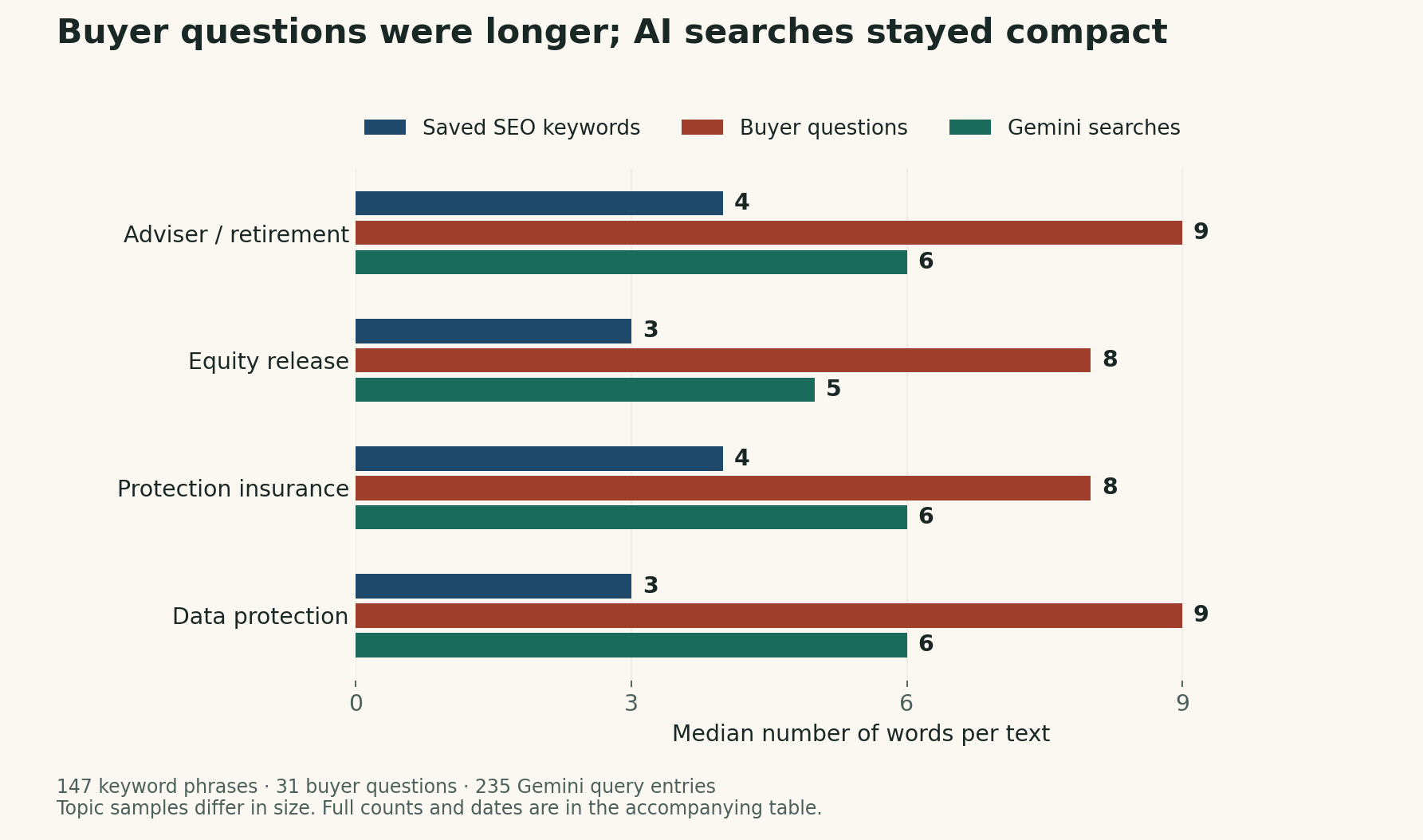
Buyer questions were longer, but the AI searches stayed compact
Across the four topics, the middle SEO phrase contained three or four words. The middle buyer question contained eight or nine. Gemini's reported searches typically contained five or six.
How the language differed
Figure 2. Median words per text. Each buyer observation is one opening question or request, rather than a whole forum post. Source: Avouch Study 1, analysed 16 October 2026. Sample sizes appear in the comparison table above.
 Open full-size chart in a new tab
Select the chart to enlarge it.
Source: Avouch Study 1: numeric results
| Topic | SEO phrase | Buyer question | Gemini search |
|---|---|---|---|
| Adviser and retirement planning | 4 words | 9 words | 6 words |
| Equity release | 3 words | 8 words | 5 words |
| Protection insurance | 4 words | 8 words | 6 words |
| Data protection | 3 words | 9 words | 6 words |
The adviser buyer sample contains only three questions. Removing town and country wording from the SEO and AI searches, then merging duplicates, preserved the direction of the length differences.
Less than 1% of the Gemini search entries exactly matched a phrase in the primary SEO list after case and punctuation were removed. The matches concerned financial advisers in Poole. Different wording can still describe the same subject and lead to the same page, so this is a measure of language overlap, not missed demand.
The more useful observation is that a detailed buying question can become several compact searches. The buyer supplies the circumstances; the searches investigate different parts of the decision.
One buying question became five searches
An AI system can issue several related searches to help answer one question. This is commonly called query fan-out. The following examples reproduce complete search sets recorded in our Gemini research.
Existing sick pay changed what the question was asking
On 15 October 2026, our research question was:
“is critical illness cover worth it if i have sick pay poole”
Gemini reported these five searches:
| Recorded search | Part of the decision it investigates |
|---|---|
| what is critical illness cover | Understanding the product |
| sick pay Poole | Existing provision in the stated location |
| Statutory Sick Pay (SSP) UK duration and amount | How long statutory provision lasts and how much it pays |
| company sick pay vs critical illness cover UK | Comparing the two |
| how critical illness cover complements sick pay | How the two relate |
80% of the searches in this set contained sick-pay wording. The question was about the relationship between a product and something the person already had. That relationship remained visible as Gemini searched for an answer.
We did not run a keyword-only control, so we cannot say which searches would have appeared without that detail. What the recorded set shows is the range of information investigated for this specific question.
An alternatives question moved beyond the original product name
On 31 August 2026, a separate research question asked:
“is equity release the best way to release money from my home in later life or are there alternatives”
Gemini reported:
| Recorded search | Part of the decision it investigates |
|---|---|
| equity release pros and cons | The trade-offs within the category |
| alternatives to equity release for older homeowners | Other options for the stated circumstances |
| downsizing pros and cons | A different way to access housing wealth |
| retirement interest-only mortgage explained | Another financing option |
| lifetime mortgage vs home reversion plan | A comparison of products |
60% of the searches in this set omitted the words “equity release”. They remained connected to the person's underlying question about accessing money from their home.
That is the useful connection between buyer language and AI search. The buyer's decision can extend beyond the service phrase a marketing team has chosen to track. In this example, the search set did too.
These observations concern Gemini's developer service. Separately, Google says AI Mode and AI Overviews may issue related searches across subtopics. Its documentation also says established SEO practices remain relevant. Google Search Central [4]
Google query data already contained some of the missing detail
We checked 368 relevant, distinct queries recorded in the clients' Google Search Console data. Search Console shows searches for which a website appeared, so it provides a different view from a saved planning list.
In data protection, 21% of the Google queries concerned cost or contract terms, compared with 0% of the saved SEO phrases. Recorded queries included “dpo pricing”, “data protection consultancy fees” and “how much does outsourced dpo cost for a 50-person saas startup?”
5% of these Google queries exactly matched our research prompts. We removed those as a check against counting our own monitoring as buyer behaviour. Cost or terms still appeared in 21% of the remaining queries. That check cannot rule out searches from other software or monitoring.
The financial-services records also included “how much does a married couple need to retire at 65”. Circumstances and buying concerns were already present in the wider search data.
This changes the interpretation of the study. The gaps we measured belonged to the saved keyword lists. They do not show that Google lacks this language, or that keyword tools cannot contain it.
Search Console is shaped by the pages a site already has and where they appear. It is not a complete record of market demand. It can also include appearances in Google's AI features, so these queries cannot be treated as a clean traditional-search comparison. Google's reporting explanation [4]
What this means for AI search research
The most useful difference was the question behind the service name. Insurance buyers asked whether cover was worthwhile. Equity-release buyers asked about alternatives. People arranging data-protection work asked about cost. The AI searches also investigated what ongoing fees covered.
These are specific buying situations that a category-led content plan can leave unexplored. The recorded searches show Gemini looking for information about those situations, including topics that no longer contain the original product name.
For marketers working on AI search optimisation, often called generative engine optimisation or GEO, that is a reason to study the decision as well as the keyword. Public discussions and real search records can reveal what needs explaining. Recorded AI searches show some of the information an engine investigates when answering a related question.
The study does not measure the total search volume behind those questions or show that adding them to a website improves recommendations. It identifies a gap between the planning terms and the decisions expressed in these samples. A content plan built from the terms alone would have left several of those decisions unstated.
Study method, dates and limits
This is an exploratory analysis of existing client research records, completed on 16 October 2026. It compares four defined topics across two markets. The sources were not collected from the same people, during the same period or through the same process.
SEO phrases. We combined saved keyword estimates, keyword suggestions and a client planning map, then removed duplicate wording and irrelevant topics. We excluded three phrases sourced solely from AI search imports, leaving 147 phrases. The estimates were saved in September to October 2026; the planning map was imported in August. An absent phrase was never treated as evidence of zero search demand.
Buyer questions. We screened public discussions from the clients' existing research libraries in a fixed, reproducible order. We selected up to eight verified discussions per financial topic and twelve for data protection. The adviser topic yielded three. Each observation is the first substantive opening question or request, with a question-shaped title taking precedence. Original sources were checked on 16 October. The sample includes older discussions and mixed geography; it is not a UK buyer survey or a verified client panel.
AI searches. We used Gemini 2.5 Flash responses with recorded search queries. Earlier selection controls collapsed repeated runs and town-only input variants before choosing the latest response to a selected wording. This comparison contains 64 research-question patterns, 235 search entries and 234 distinct searches, captured between 18 August and 15 October 2026. The prompts were designed for research and often contained buying conditions. Search-free answers are outside the sample, so it cannot establish how often Gemini searches or fans out overall.
Percentage presentation. Percentages are rounded to the nearest whole percent; word counts and sample sizes keep their original units. The opening 63% is 5 of 8 buyer questions. The Google cost comparison rounds to 21% both before excluding exact research-prompt matches (23/111) and afterwards (22/106); the excluded matches are 5/111, rounded to 5%. Exact SEO/AI wording overlap is 2/235, below 1%. The 80% and 60% fan-out results describe 4/5 and 3/5 searches in individual recorded sets. They do not estimate how often all AI searches behave that way.
Language and intent. The same word-counting rule was applied to every text. The tables report medians, the middle counts, rather than averages. One AI analyst, Codex, assigned and reviewed overlapping intent categories based on the words explicitly present. The analyst could see the source type; the coding has not been independently validated. The figures describe these selected texts, not population-wide proportions or a causal effect of question wording.
Google cross-check. We used 257 relevant distinct financial-services query records from an export dated 6 July and 111 data-protection query records captured on 7 to 13 October. Repeated daily appearances were counted once. These are site-dependent observations, not authenticated buyer logs. Removing exact research-prompt matches is a limited contamination check.
Robustness and boundaries. Removing town/country wording and merging duplicate resulting phrases preserved the direction of the language differences. Restoring the three known AI-origin keyword rows left topic medians unchanged and raised exact AI-to-keyword matches from two to four. The analysis does not measure missed market demand, final-answer quality, recommendations, enquiries or sales. Public buyer questions and model tests remain separate, topic-matched sources.
Read the full method and results [5], buyer-question source register [6] and numeric results [7].
Research that informs the work
Avouch uses buyer research to inform website and SEO work, content and relevant activity beyond the website. For an agreed project, we can investigate the questions around a purchase and turn the research into pages and supporting content, with scope and outputs agreed before work starts. The forums in this study supplied buyer language; the study does not show that posting on a particular platform causes AI recommendations.
Related research: How much AI visibility can SEO explain? [8]