
How to get your software onto best-of lists AI cites
Find the lists AI already cites for your category, give the writer a reason and the means to test you, and publish an honest comparison of your own.
 Steen Stones · Reviewed
Photo: Pixabay / Pexels
Find the lists AI tools already cite when your buyers ask about your category, check that each one is for your kind of buyer, and give the writer a reason to include you and a way to test your product. Where a good publisher has no list yet, suggest one. Then publish an honest comparison on your own site.
Avouch is an AI SEO agency for tech companies. Earning places on the lists AI cites is part of the work we do beyond our clients’ websites.
Why best-of lists are worth the effort
In Ahrefs’ study of ChatGPT answers to 750 early buying questions about software, products and agencies, “best X” blog lists made up 43.8% of the page types cited, more than any other kind of page. Brands placed higher on other publishers’ lists were also more likely to appear in the answers. In our own research on one market, comparison and ranking sites were the sources that most often decided who AI recommended. Neither study shows that getting onto a list causes a recommendation, but both show where AI tools look. Our guide to why comparison sites matter explains the different kinds of list.
Step by step
Ask the AI tools your buyers use the questions they ask, such as “best onboarding software for a B2B SaaS company”, and save every list they cite.
Open each list. Ahrefs warns that some citations are only loosely related, so check the list is about your category and that your competitors appear in the right context.
Keep the lists for your buyer. Skip lists written for a different kind of buyer, even when a rival is on them.
Find the publishers with no list yet. Look for trusted sites in your space that have not published a comparison, and suggest one.
Pitch the writer, not the ranking. Explain the buyer problem you solve, show your evidence and offer a demo or a free trial, so the writer can judge you first-hand.
Check the result later, in the AI answers as well as on the list.
What to send the writer
Give the writer what a good review needs. Google’s guidance for review writers asks for first-hand evidence, what sets a product apart, benefits and drawbacks, and a reason for calling anything “best”. That is Google’s standard, not a rule for every AI tool, but it describes a list worth being on.
| What to send | Why it helps |
|---|---|
| Access to test the product | A demo or free trial lets the writer form their own view, which is what makes the list credible |
| Who it is for, and who it is not for | The writer can place you under the right “best for” heading |
| What sets you apart | Writers are asked to explain the differences between options, so give them real ones |
| Evidence they can check | Screenshots, customer examples and review profiles back up what you say |
| Honest limits | A list that covers drawbacks is more useful, and your honesty makes the rest believable |
What Google asks review writers to show
Google Search Central, captured 8 October 2026; the guidance was last updated on 10 December 2025 and still says the same on 23 October 2026. Documentation licensed CC BY 4.0.
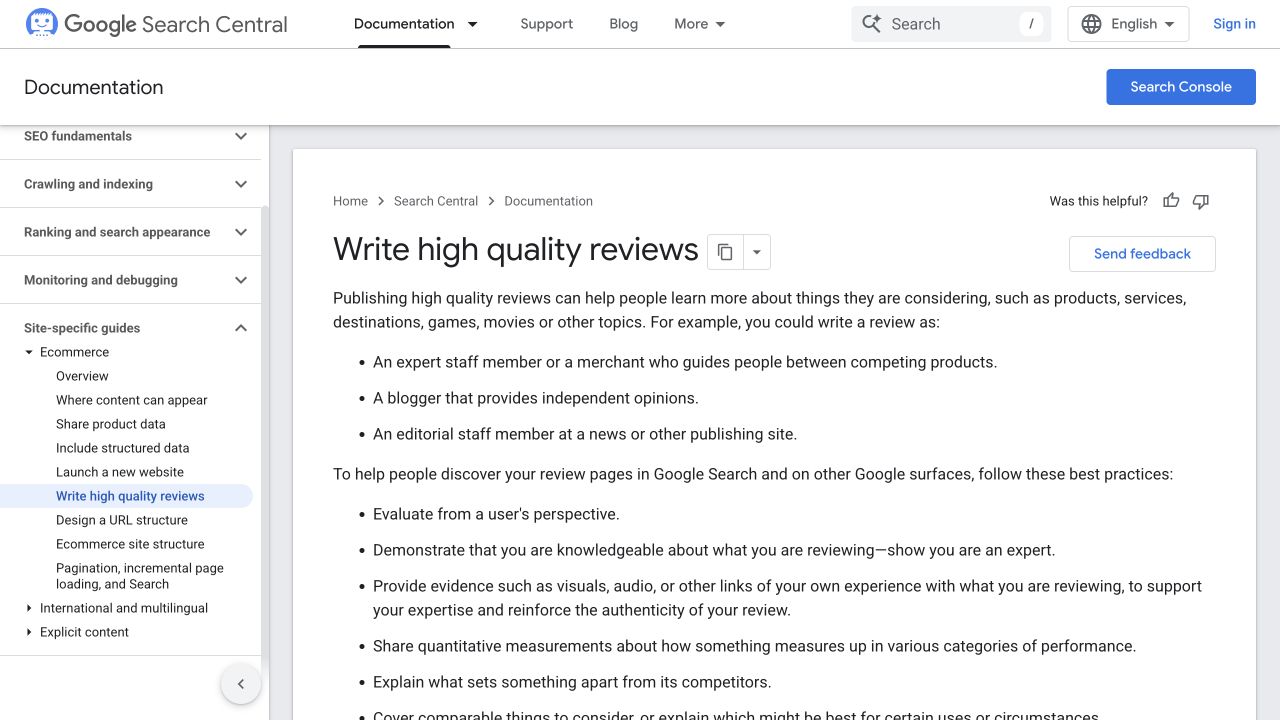 Open full-size screenshot in a new tab
Select the screenshot to enlarge it.
- Evidence of experience
- The guidance asks writers to support a review with material from their own experience.
- Product differences
- Help the writer see what sets your product apart.
- Scope
- This is Google’s review guidance, not proof that an AI tool will cite a page.
Publish an honest comparison of your own
Your own comparison pages count too. Ahrefs found ChatGPT citing Asana’s own project management list, where Asana ranked itself first, as well as a Zapier list that placed Asana second. But self-promotion is everywhere: in Ahrefs’ check of 250 Google results for “best X software” searches, 169 (67.6%) included a list written by a company that ranked itself first. A self-ranked list is easy for a buyer to discount, so make yours earn its place.
Say that you sell one of the products at the top of the page.
Explain who each option suits, including when a rival is the better choice.
Give enough detail for the list to stand on its own, as Google asks of ranked lists.
Link to the alternatives so readers can check them. Ahrefs says it does this on its own comparisons.
Back up every “best” with evidence, not adjectives.
How to judge the result
Getting onto a list is a step, not the result. Ask the same buyer questions again and record three things separately: whether the list is cited, whether your product is named, and whether it is recommended for the buyer’s need. About half the websites AI cites for a question change from one day to the next, so check more than once. Our guide to AI visibility metrics explains the difference between being named and being recommended.
Review platforms are lists too. Our guide to G2 and Capterra reviews covers them, and our guide to how software buyers build shortlists shows where lists sit in a buyer’s research.
How Avouch can help
We find the lists AI cites for your category and work to earn a fair place on them through digital PR and industry coverage, and we write honest comparison pages for your own site through our content work. We agree the scope and the price before work starts.
Want to talk it through?
Talk to us about the lists in your category. To see which lists AI tools cite when your buyers ask, start with a free scan.